
Slabs · Driveways · Foundations · West Texas
Concrete Contractor in Lubbock & West Texas
Driveways, slabs, foundations, shop floors, and pads — poured on ground we prepared ourselves, built for West Texas soil and weather.
Licensed & Insured · We Prep Our Own Base · Local West Texas Crew · Free On-Site Estimates
A slab is only as good as its base
We do the dirt work and the concrete, so nobody gets to point fingers.
Concrete built for this ground
Most concrete that fails out here didn’t fail because of the concrete. It failed because of what was under it. A base that wasn’t compacted, soil that moves when it gets wet and shrinks when it dries, no control joints to tell the slab where to crack. The pour is the easy part. The ground underneath is where the job is won or lost.
That’s the advantage of hiring a crew that does both. We excavate, grade, and compact the base ourselves, then pour on top of it. If a slab we poured has a problem, it’s ours — there’s no dirt contractor to blame and no finger-pointing for you to referee. We also work with West Texas weather rather than against it, because heat, wind, and low humidity all pull moisture out of fresh concrete faster than most people expect.
What we pour
Residential, commercial, and agricultural concrete.
Driveways & approaches
Residential and commercial driveways poured to hold up to real use.
Slabs & foundations
House slabs, additions, and structural foundations poured to plan.
Shop & barn floors
Heavy-duty floors sized for equipment, vehicles, and working loads.
Patios & sidewalks
Patios, walkways, and flatwork finished clean and square.
Equipment & RV pads
Thick pads built to carry trailers, equipment, and heavy loads.
Tear-out & replacement
Old failing concrete removed, base corrected, new concrete poured.
Where cheap concrete gets expensive
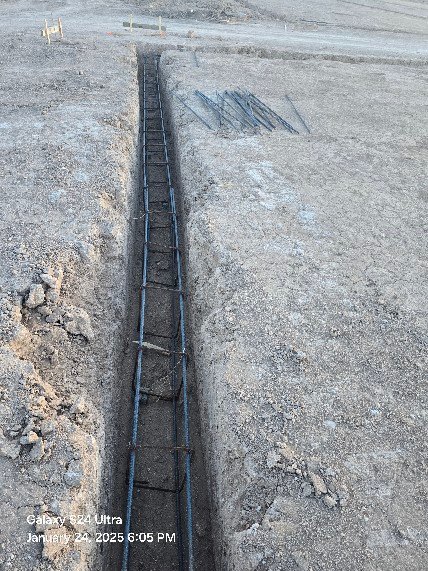
The three shortcuts that cost people the most: pouring too thin for the load, skipping reinforcement where it’s needed, and not preparing the base. All three save money on the day of the pour and cost several times that within a few years, because the fix is tearing the whole thing out and starting over.
We’ll tell you what your pour actually needs — and just as importantly, what it doesn’t. If you don’t need rebar for a small patio, we’re not going to sell you rebar.
Recent concrete work
Real projects from around Lubbock and West Texas.
Concrete FAQs
How much does a concrete slab or driveway cost in Lubbock?
It depends on square footage, thickness, how much prep the ground needs, and whether reinforcement or a thickened edge is required. A flat, already-graded site pours cheaper than one that needs excavation and fill. We come out, measure, and give you a free estimate based on your actual site.
Why does concrete crack out here?
Some hairline cracking is normal in any slab as it cures and shrinks. The cracks that matter come from ground that wasn’t prepared right: poor compaction under the slab, soil that moves with moisture, or no control joints. Prep is what separates a slab that lasts from one that fails.
What is a control joint and why does my slab need them?
Control joints are the grooves cut or tooled into a slab at set intervals. Concrete is going to shrink and crack as it cures. Control joints decide where it cracks, so it happens in a straight line you barely notice instead of randomly across the middle of your driveway.
How thick should my concrete be?
It depends on what’s going on top of it. Sidewalks and patios need less than a driveway, and a driveway needs less than a slab that will hold equipment or heavy trucks. Pouring too thin to save money is the most expensive shortcut in concrete. We size it for the actual load.
Does concrete need rebar or wire mesh?
For most driveways, shop floors, and structural slabs, yes. Reinforcement doesn’t stop concrete from cracking, but it holds the slab together when it does, so the pieces don’t separate and shift. We’ll tell you what your pour actually needs rather than adding cost for no reason.
How long before I can drive on new concrete?
You can usually walk on it within a day, but vehicles need to wait considerably longer while the concrete gains strength. Driving on it too early can crack a slab that would otherwise have been fine. We’ll give you specific timing for your pour before we leave the site.
Does West Texas heat and wind affect a concrete pour?
A lot. Heat, low humidity, and wind pull moisture out of fresh concrete fast, which can weaken the surface and cause cracking if it isn’t managed. That means timing the pour, and curing it properly afterward. It’s one of the reasons a local crew that knows this climate matters.
Can you pour in the winter?
Yes, with precautions. Concrete needs to stay above freezing while it sets, so cold-weather pours need planning and protection. We’ll tell you honestly if the forecast means waiting a few days is the better call — a delayed pour beats a compromised one.
Do you prepare the ground before pouring?
Always, and it’s the part that determines whether the slab lasts. We excavate, grade, and compact the base properly. A beautiful pour on a badly prepared base will fail, and no amount of good finishing work saves it.
Can you do the excavation and grading for the pour too?
Yes. We handle the dirt work and the concrete, which means the base gets prepared by the same crew responsible for the slab that sits on it. Nobody gets to blame anybody else.
Do you pour shop and barn floors?
Yes. Shop floors, barn slabs, and equipment pads are regular work for us, and they get designed for the loads they’ll actually carry rather than residential specs.
Can you pour a slab for a barndominium or metal building?
Yes. Metal building and barndominium slabs typically need specific dimensions, thickened edges, and anchor bolt placement matching your building plans. Bring us the plans and we’ll pour to them.
Can you replace old cracked concrete?
Yes. We tear out failing concrete, haul it off, correct whatever was wrong with the base underneath, and pour new. Pouring fresh concrete over a bad base just gives you a new slab with the same problem.
Do I need a permit for concrete work?
It depends on your city or county and what you’re pouring. A structural foundation usually requires permitting; a patio replacement often doesn’t. Work in a right-of-way or easement generally does. We check what applies before we start.
Can you handle the concrete, septic, and site work together?
Yes, and that’s the advantage. One crew doing the excavation, the septic system, the utilities, and the concrete means one schedule and one point of accountability instead of coordinating separate contractors who each blame the other.
How do I get an estimate for concrete work?
Call (806) 782-5800. We’ll come out, look at the site, talk through what you’re wanting, and give you a clear, no-pressure estimate.
Where we pour
Lubbock · Levelland · Shallowater · Wolfforth · Idalou · Slaton · Ropesville · Brownfield · Littlefield · Plainview
Don’t see your town? Give us a call — if you’re within about sixty miles of Lubbock, we probably cover you.
Ready to pour?
Free on-site estimates across Lubbock and West Texas. We’ll look at the site and tell you straight what it needs.
info@reddirtditchingandseptic.com
4310 Private Road 1040, Lot C · Lubbock, TX 79407
Mon–Fri: 7am–6pm